
Why Some Property Projects Outperform Others.
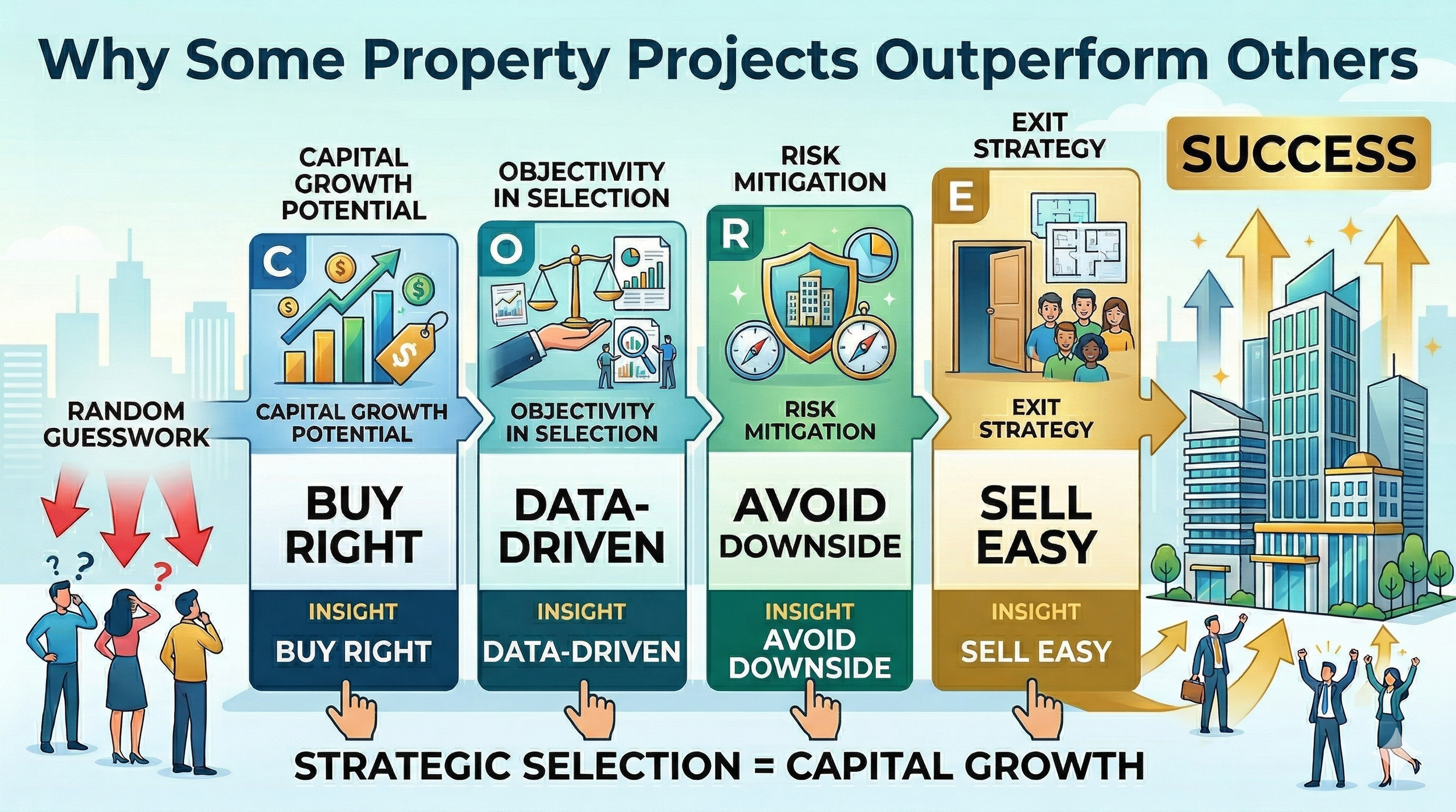
Why Some Property Projects Outperform Others
(Using the C.O.R.E Framework™)
Many buyers think property success comes down to luck, timing, or simply choosing a “good project.”
But after working with many clients, one thing becomes very clear:
👉 Top-performing properties are not chosen randomly — they are selected strategically.
This is where the C.O.R.E Framework™ comes in.
Instead of guessing, you can evaluate every project based on 4 key pillars:
C – Capital Growth Potential
O – Objectivity in Selection
R – Risk Mitigation
E – Exit Strategy
Let’s break down why some projects outperform others using this framework.
C – Capital Growth Potential
(Why Entry Price Is Everything)
The biggest driver of performance is not the project itself —
👉 it’s how you enter the project.
Projects that outperform usually:
Are bought at a price gap to surrounding properties
Enter the market at fair or undervalued pricing
Have room for future price growth
Projects that underperform:
Are bought at peak prices
Already reflect future potential
Leave little room for upside
💡 Key Insight:
You don’t make money when you sell.
👉 You make money when you buy right.
O – Objectivity in Selection
(Avoid Emotional Buying)
Many buyers choose properties based on:
Showflat design
Marketing hype
“Nice feeling”
But outperforming projects are selected based on:
✔ Price comparison with nearby developments
✔ Demand vs supply in the area
✔ Data, not emotions
For example:
If 3 nearby projects are at $1,9xx psf
And a new launch is at $2,2xx psf
👉 You must ask:
“Is this justified — or am I overpaying?”
💡 Key Insight:
Emotion buys homes.
Objectivity builds wealth.
R – Risk Mitigation
(Why Some Projects Stagnate)
Not all properties carry the same level of risk.
Projects that underperform often have hidden risks:
Too many competing developments nearby
Weak demand from genuine buyers
Over-supply in the area
Poor layout or inefficient unit mix
On the other hand, outperforming projects:
Have limited competition
Strong owner-occupier demand
Balanced supply pipeline
💡 Key Insight:
It’s not just about upside.
👉 It’s about avoiding downside.
E – Exit Strategy
(The Most Overlooked Factor)
This is where many buyers get it wrong.
Before buying, always ask:
👉 “Who will buy this from me in the future?”
Projects that outperform typically:
Appeal to a large buyer pool
Have practical layouts (2–3 bedders)
Are near MRT / amenities
Suitable for families
Projects that struggle:
Have niche layouts
Limited target audience
Hard to resell
💡 Key Insight:
If it’s hard to sell, it’s hard to grow.
Bringing It All Together
Projects that outperform are not just “good projects.”
They are projects where:
✔ C – Entered at the right price
✔ O – Selected based on data, not emotions
✔ R – Risks are minimised
✔ E – Strong exit demand is present
When all 4 align,
👉 the probability of strong capital appreciation increases significantly.
Final Thoughts
The difference between an average property and a top-performing one is not luck.
👉 It’s strategy and selection.
Two buyers can enter the same market —
but achieve completely different results.
Because one follows hype,
and the other follows a framework.
✅ If you’re considering a new launch or resale property, and want to know whether it passes the C.O.R.E Framework™, feel free to reach out.
I can help you break down:
Entry price vs market
Risk factors
Exit potential
So you can make a more confident and future-proof decision.
