
My Property Is Not Making Money. Should I Cut Loss or Continue to Hold?
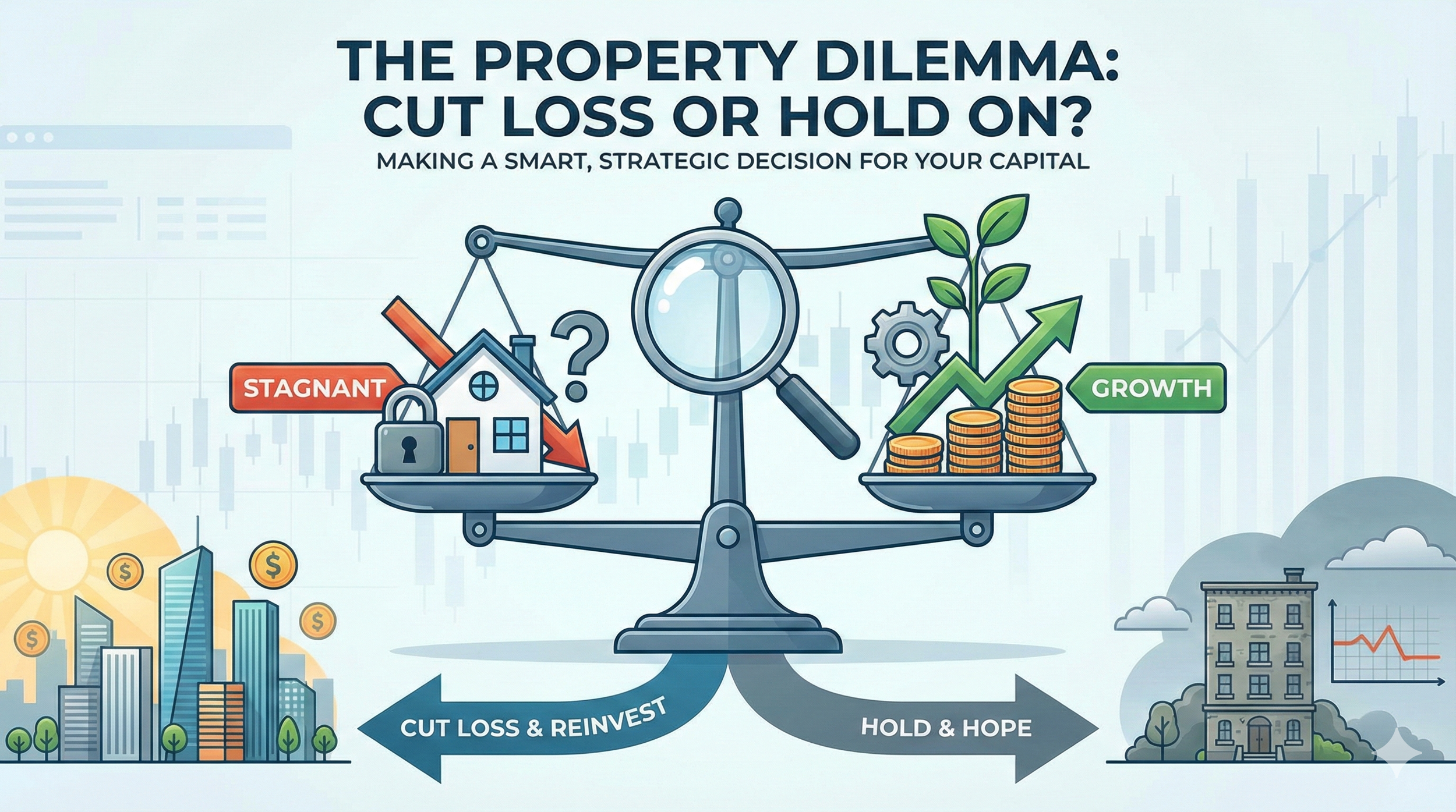
My Property Is Not Making Money. Should I Cut Loss or Continue to Hold?
This is a question I get asked very often.
“I bought this property years ago. It’s been rented out all this while, but when I look at the numbers properly… I don’t feel like it’s really making money.”
If you’re in this situation, you’re not alone.
And the answer is not always “sell immediately” or “just hold longer”.
The right decision depends on why the property is not performing — and what you are giving up by holding it.
Let’s break this down properly.
Step 1: First, Define What “Not Making Money” Really Means
Many owners say a property is “not making money”, but they often mean different things:
Rental just enough to cover mortgage, or still topping up monthly
No visible capital appreciation over many years
Returns are lower compared to other properties bought around the same time
Money is stuck, but not growing meaningfully
Before deciding anything, ask yourself honestly:
👉 Is the property underperforming… or just under-expected?
These are very different situations.
Step 2: Look Beyond Rental – Evaluate the Total Performance
A property should be evaluated on total return, not rental alone.
Ask yourself:
Over the entire holding period, how much capital appreciation has there been?
How much cash (CPF + cash) has gone in?
If you sell today, what is your real net outcome after costs and taxes?
If after many years:
Capital appreciation is weak
Rental is stagnant
Opportunity cost is high
Then holding on just because you’ve already held for long may not be the best strategy.
Step 3: The Real Question Is Not “Cut Loss or Not”
The more important question is:
👉 “If I continue to hold this property for the next 5–10 years, is this the best use of my capital?”
Holding a property has a cost:
Locked-up capital
Opportunity cost
Slower wealth progression
If the same capital can be redeployed into:
A stronger growth location
A better entry price
A clearer exit strategy
Then selling is not cutting loss — it’s restructuring.
Step 4: When Does It Make Sense to Continue Holding?
Holding may still make sense if:
The property is in a proven growth location
Supply is tightening and future upside is still strong
Rental demand is stable and improving
The next growth cycle has not yet played out
In such cases, the issue may not be the property itself — but timing.
Step 5: When Selling and Reinvesting Is the Smarter Move
Repositioning your asset often makes sense when:
The property has already peaked in its growth cycle
Rental growth is capped
New competing supply keeps coming
Your capital is better used elsewhere
Many successful investors didn’t grow their wealth by holding one property forever — they grew by recycling capital from underperforming assets into stronger ones.
Final Thought: Don’t Let Emotions Make the Decision
A property is not a trophy. It’s a financial tool.
The goal is not to “win” by holding longer — the goal is to make your money work harder for you.
Before deciding to sell or hold, always run a proper comparison:
Hold vs Exit
Status quo vs Opportunity cost
Emotional comfort vs Financial clarity
Sometimes the best move forward is not holding tighter — but making a smarter move sideways, then forward.
If you’ve ever wondered whether your current property is still pulling its weight, a proper C.O.R.E analysis can often reveal answers that numbers alone don’t.
A quick clarity check today can prevent years of stagnation tomorrow.
If you’d like, I’m happy to walk through a non-obligatory C.O.R.E review of your existing property — just to help you see where you stand and what options you actually have.
